Vertical Farming Systems: How Controlled Environments Redefine Food Production

Vertical farming systems represent a fundamental shift in how food can be grown in constrained spaces. Instead of relying on large horizontal fields and seasonal weather patterns, these systems stack crops vertically and manage every aspect of the growing environment. As urbanization accelerates and climate pressures increase, vertical farming has moved from experimental concept to serious agricultural model, raising important questions about efficiency, resilience, and sustainability.

At its core, vertical farming is not about novelty or high-tech spectacle. It is about applying biological principles within carefully controlled environments to produce consistent yields. Understanding how these systems work requires looking closely at structure, climate control, lighting, water management, and automation, all of which must operate together for plants to thrive.

Vertical Farming

Structural Foundations of Vertical Farming

The architectural arrangement of a vertical farming system is both the way plants are positioned, accessed, and sustained and the way spacing among them creates a growth environment. Unlike conventional greenhouses, these setups utilize vertical space at many parts of the building and the system must be structured to best use so much growth surface per meter square. A well-designed architectural decision can have an impact on not only airflow and lighting efficiency but also plant maintenance and major architectural restructure in the long run.

Overall, the expansions in the system are in modules, which can be used further or reconfigured as needed. This flexibility allows operators to adapt the configurations per crop type, growth stage, or operational constraints. Yet, to understand the exact nature, both opportunities and challenges are introduced by stacking plants vertically.

Stacked Growing Racks and Layers

Stacked growing systems use shelves or racks to hold multiple layers of crops, sometimes extending several meters high. Each layer functions as an independent growing zone while remaining part of a unified system. This arrangement dramatically increases production density compared to horizontal farming.

However, stacking introduces complexity. Upper and lower layers experience different heat patterns, airflow, and access constraints. Successful systems account for these variations through careful spacing, uniform lighting, and precise environmental controls that keep conditions consistent across all levels.

Space Optimization and Load Considerations

Vertical farms must account for structural loads created by water, plants, growing media, and equipment. Floors, shelving, and support frames are engineered to handle significant weight over time. In urban settings, this often determines whether a building is suitable for conversion into a farm.

Beyond safety, space optimization affects operational efficiency. Narrow aisles, ceiling heights, and access points influence how easily crops can be planted, monitored, and harvested. Thoughtful design balances density with human and robotic movement requirements.

Accessibility and Maintenance Design

Routine maintenance is unavoidable in any farming system, and vertical farms are no exception. Structural layouts must allow for regular cleaning, equipment servicing, and crop handling without disrupting neighboring layers.

Designs that ignore accessibility often lead to higher labor costs or increased downtime. For this reason, many systems incorporate movable racks, adjustable shelves, or designated service corridors that simplify daily operations while maintaining high planting density.

Controlled Climate and Environmental Management

A core feature of vertical farming is the management of the climate. Taking over from the natural elements, these systems are under tight control inside greenhouses or other enclosed environments where they dictate the temperature, humidity, carbon dioxide levels, and airflow. Climate regulation ensures that crops receive a year of stable growth conditions.

Climate management is only about holding what others might drag to extremes within a narrow range that the particular plant can cope with. Any slight deviations might depress growth, make them more prone to disease or insect attacks, and could become a big issue too. To little an increase from the desired concentration of carbon dioxide could lead to less photosynthesis. This would most likely slow plant growth and productivity, which could lead to increased disease during that time. So it all has to be monitored closely, which is another big point to consider.

Temperature Regulation Across Growth Cycles

Different crops, and even different growth stages, require specific temperature ranges. Seedlings often prefer warmer conditions, while mature plants may tolerate or benefit from cooler environments. Vertical farming systems adjust temperatures dynamically to match these needs.

Uniform temperature distribution is a common challenge in stacked environments. Heat generated by lighting and equipment must be managed to prevent hotspots. Ventilation systems and heat exchangers help distribute warmth evenly across layers.

Humidity Control and Plant Health

Humidity influences transpiration, nutrient uptake, and disease development. Excess moisture can encourage fungal growth, while air that is too dry can stress plants and reduce yields. Vertical farms rely on sensors and dehumidification systems to keep humidity within optimal ranges.

Because plants release moisture into the air, humidity levels fluctuate throughout the day. Effective systems respond in real time, adjusting airflow and moisture removal to maintain stability without wasting energy.

Airflow and Carbon Dioxide Balance

Proper airflow ensures that fresh air reaches plant surfaces and that excess heat and humidity are removed. In dense vertical systems, stagnant air can lead to uneven growth or localized disease outbreaks.

Carbon Dioxide enrichment is sometimes used to boost photosynthesis, particularly in tightly sealed environments. This practice requires careful control to ensure concentrations benefit plants without compromising worker safety.

Lighting Systems and Photosynthesis Management

In urban agriculture systems the most important inputs are light lacking the presence of sunlight. Artificial light intensity, spectrum, and duration must be suitable to promote good crop development and save energy.

The decision on lighting not only affects crop development but also the generation of heat and the operating costs. Hence lighting design should be closely tied with climate and building architecture.

Spectrum Selection and Plant Response

Plants respond differently to various wavelengths of light. Blue light influences leaf development and compact growth, while red light supports flowering and biomass accumulation. Vertical farming systems tailor light spectra to match crop requirements.

Rather than replicating full sunlight, most systems use targeted spectra that emphasize wavelengths plants use most efficiently. This approach reduces wasted energy while maintaining predictable growth patterns.

Light Intensity and Distribution

Light intensity must be sufficient to drive photosynthesis without causing stress or leaf damage. In stacked systems, ensuring even distribution across each layer is essential to avoid uneven growth.

Fixtures are positioned close to plant canopies to improve efficiency, but this proximity requires precise control to prevent overheating. Adjustable mounting systems allow lights to move as plants grow.

Photoperiods and Growth Scheduling

The length of daily light exposure, known as the photoperiod, influences plant behavior. Some crops require long daylight hours, while others respond to shorter cycles. Vertical farms manipulate photoperiods to control growth rates and harvest timing.

By staggering lighting schedules across zones, farms can smooth energy demand and maintain continuous production. This scheduling flexibility is a key advantage over outdoor agriculture.

Water, Nutrients, and Root Zone Management

Vertical farming systems typically use soil-free growing methods that deliver water and nutrients directly to plant roots. This approach reduces water waste and allows precise control over nutrient availability.

Managing the root zone is as important as managing the visible parts of the plant. Healthy roots support efficient nutrient uptake and overall plant resilience.

Hydroponic and Aeroponic Approaches

Hydroponic systems grow plants in nutrient-rich water solutions, while aeroponic systems mist roots with nutrients suspended in air. Both methods eliminate traditional soil and reduce the risk of soil-borne diseases.

Each approach has trade-offs. Hydroponics offers simplicity and stability, while aeroponics can improve oxygen availability but requires more precise control. System choice depends on crop type and operational goals.

Nutrient Solution Monitoring

Plants require a balanced mix of macro and micronutrients. Vertical farms monitor nutrient concentrations, pH levels, and electrical conductivity to ensure solutions remain within target ranges.

Automated dosing systems adjust nutrient levels as plants grow and absorb elements at different rates. Regular monitoring prevents deficiencies and excesses that could affect yield or quality.

Water Efficiency and Recycling

One of the key advantages of vertical farming is water efficiency. Closed-loop systems recirculate water, capturing runoff and reducing overall consumption compared to field agriculture.

Filtration and sterilization processes maintain water quality over time. By minimizing losses, vertical farms can operate in regions where water scarcity limits traditional farming.

Automation, Monitoring, and Data Integration
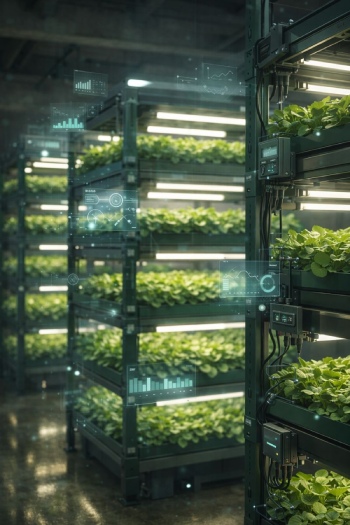
Data Integration & Automation

Automation supports the complexity of vertical farming by reducing manual labor and improving consistency. Sensors, software, and control systems work together to maintain stable growing conditions.

Data-driven management allows operators to identify patterns, optimize settings, and respond quickly to issues. This integration transforms farming into a process of continuous adjustment rather than seasonal intervention.

Environmental Sensors and Feedback Loops

Sensors measure temperature, humidity, light levels, nutrient concentrations, and more. These inputs feed into control systems that adjust equipment automatically to maintain setpoints.

Feedback loops ensure that changes are based on real conditions rather than fixed schedules. This responsiveness improves plant health and reduces resource waste.

Labor Reduction and Task Automation

Automation can handle tasks such as irrigation, lighting control, and climate adjustment. In some systems, seeding and harvesting are partially automated to improve efficiency and reduce repetitive labor.

While automation reduces manual effort, human oversight remains essential. Skilled operators interpret data, make strategic decisions, and handle exceptions that automated systems cannot resolve.

Data Analysis and Continuous Improvement

Over time, vertical farms accumulate large volumes of operational data. Analyzing this information helps refine growing recipes, predict yields, and identify inefficiencies.

Continuous improvement relies on experimentation within controlled conditions. Small adjustments can be tested and evaluated quickly, accelerating learning compared to outdoor agriculture.

Operational Challenges and System Limitations

Operational Challenges

Despite their advantages, vertical farming systems face practical constraints. Energy use, capital costs, and technical complexity can limit feasibility depending on location and scale.

Understanding these limitations is essential for realistic evaluation. Vertical farming is not a universal replacement for traditional agriculture, but a complementary approach suited to specific contexts.

Energy Demand and Efficiency Trade-Offs

Artificial lighting and climate control require significant energy inputs. Improving efficiency is a constant priority, but energy costs remain a major operational factor.

System design, scheduling, and equipment selection all influence energy use. Balancing productivity with consumption determines long-term viability.

Scale, Economics, and Crop Selection

Not all crops are well suited to vertical farming. Leafy greens and herbs thrive under controlled conditions, while larger fruiting crops present greater challenges.

Economic viability depends on matching system capabilities with market demand. Crop selection, yield consistency, and operational efficiency must align to justify investment.

Technical Complexity and Risk Management

Highly integrated systems introduce points of failure. Equipment malfunctions, power outages, or software errors can disrupt entire operations if not managed carefully.

Redundancy, maintenance planning, and staff training reduce risk. Successful vertical farms treat reliability as a core design principle rather than an afterthought.

Growing Upward With Purpose

The vertical farming systems function as an interwoven entity of structure, climate control, lighting, water management, and automation, making vertical farming a refined way to standardize and mass-produce food irrespective of the weather outside. This technology is not merely about high-tech solutions, but more significantly a symbiotic engagement with locality-where the growing circumstances of the plant directly affect how people can compassionately design vertical farming. Some biologically designed mechanisms can thereby draw on companionship with living beings.

>