From Seasonal Dependence to Year-Round Production
Traditional agriculture is shaped by seasons, daylight cycles, and regional climate. While this system has supported human societies for millennia, it is increasingly strained by unpredictable weather events and shifting growing zones. Controlled-environment agriculture reduces dependence on these external cycles by creating stable, repeatable conditions indoors.
Year-round production allows growers to plan output with greater accuracy. For food distributors and institutions, this predictability reduces exposure to seasonal shortages and price fluctuations, especially for perishable crops.
Managing Temperature, Humidity, and Airflow
Within controlled environments, temperature and humidity are adjusted to match the needs of specific crops. Airflow is also carefully managed to reduce disease pressure and support uniform growth. These variables are monitored continuously rather than addressed reactively.
The result is a growing environment where stress factors are minimized, allowing plants to direct more energy toward growth rather than survival. This level of control is difficult to achieve in open fields, even with advanced farming practices.
Light as a Production Input
In vertical farming systems, light is treated as a precise and adjustable input rather than a fixed natural condition. Artificial lighting allows growers to tailor light intensity, duration, and spectrum to different growth stages.
This approach decouples plant development from geographic location and daylight availability. Crops can be grown in dense urban areas, regions with limited sunlight, or climates that would otherwise restrict production.
Water Use and Nutrient Efficiency
Water scarcity is one of the defining challenges facing global agriculture. Vertical farming systems typically use closed-loop water circulation, delivering moisture and nutrients directly to plant roots and capturing excess for reuse.
Compared to conventional irrigation, this method significantly reduces water loss through evaporation and runoff. Nutrients are applied with precision, limiting waste and environmental impact.
Food Security in an Unstable World
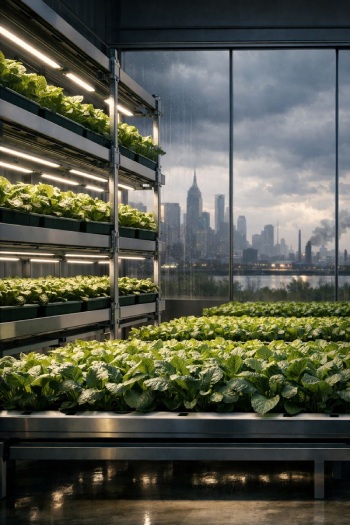
When discussing such issues as food security, the focus could very well be on the quantity of food stocks; yet, it is important to consider the related aspects of food stability and food access. In long-term plans, global supply chains have let the world conveniently adopt a year-round food-growing strategy, while they rule out such vulnerabilities as presented in chapter four. Ride the vicious circle of climate events, political conflicts, or transportation shutdowns anywhere.
Vertical farming is an important source of food security, offering localized fresh produce. It cannot cover every food need. Nevertheless, it supports the resilience of systems by allowing us to in support of distant food sources.
Reducing Exposure to Long Supply Chains
Modern cities often depend on produce transported over long distances. This reliance increases sensitivity to fuel prices, labor shortages, and infrastructure disruptions. Local indoor farming reduces the number of steps between harvest and consumption.
Shorter supply chains are not inherently better in all cases, but they can improve reliability for certain crops, particularly those with short shelf lives.
Continuity During Disruptions
Recent global events have highlighted how quickly supply chains can be disrupted. Border closures, port congestion, and labor constraints have all affected food availability in different regions. Indoor farming facilities, operating independently of weather and seasonal cycles, can continue producing even when external systems falter.
This continuity provides a stabilizing influence rather than a complete solution, helping buffer cities against temporary shortages.
Nutritional Quality and Freshness
Time is a critical factor in food quality. Many fruits and vegetables lose nutritional value after harvest, especially during extended transport and storage. Producing food closer to consumers reduces this delay.
Greater freshness can translate into improved taste and nutrient retention, supporting public health outcomes alongside supply stability.
Urban Farming and the Reuse of Space

Cities consume the majority of the world’s food but produce relatively little of it. This separation has shaped urban planning for decades, often relegating food production to distant rural areas. Vertical farming challenges this model by integrating agriculture into the urban fabric.
Urban farming in this context is less about tradition and more about efficiency, proximity, and spatial adaptation.
Repurposing Industrial and Commercial Buildings
Many vertical farms are located in warehouses, former factories, or underutilized commercial spaces. These buildings often have limited alternative uses but can support agriculture with appropriate infrastructure upgrades.
Repurposing existing structures reduces the need for new land development and aligns food production with urban regeneration efforts.
Vertical Stacking and Land Efficiency
Growing crops in stacked layers dramatically increases output per square meter. This approach is particularly valuable in dense urban environments where land availability is constrained.
Vertical stacking does not eliminate land use concerns, but it reframes how space is allocated for food production within cities.
Reducing Urban Food Waste
Food waste is a persistent challenge in urban systems. Produce transported over long distances is more likely to be damaged or spoiled before reaching consumers. Local production reduces handling steps and transit time.
Lower waste levels benefit both economic efficiency and environmental sustainability, especially in cities with strained waste management systems.
Visibility and Public Awareness
When food is produced within city limits, it becomes more visible to residents. Even when farms are not publicly accessible, their presence can influence how people think about food systems.
This visibility supports broader awareness of resource use, sustainability, and the complexity of modern agriculture.
Data-Driven Food Production
The reliance on data constitutes one of the defining characteristics of vertical farming. Continuous environmental and crop performance data are collected by sensors and control systems. The data-driven approach enables an analytical frame instead of an empirical one in which agriculture is done. Decisions today are made on the basis of the real outcomes instead of merely the seasonal experience.
Environmental Sensors and Real-Time Monitoring
Temperature, humidity, carbon dioxide levels, and nutrient concentrations are monitored continuously. When conditions deviate from target ranges, adjustments can be made quickly and precisely.
This responsiveness reduces the lag between problem detection and intervention, supporting more stable growing conditions.
Feedback Loops and System Optimization
Data collected from each growth cycle informs future adjustments. Small changes in lighting schedules or nutrient delivery can be tested and evaluated over time.
These feedback loops support gradual optimization, allowing systems to improve efficiency and output incrementally rather than relying on trial and error across seasons.
Standardization and Replicability
Once optimal growing conditions are established, they can be replicated across multiple facilities. This repeatability supports expansion without requiring identical local environments.
Standardization also simplifies training and quality control as operations scale.
Changing Skill Requirements in Agriculture
As automation and data analysis become more central, the skills required in vertical farming differ from traditional agriculture. Technical expertise, system maintenance, and operational oversight play a larger role.
This shift does not remove the need for human involvement but reshapes the nature of agricultural labor.
Energy Consumption and Power Sources
Artificial lighting and climate control require energy, making power consumption one of the largest environmental considerations. Efficiency improvements have reduced energy intensity, but sourcing remains critical.
Facilities powered by low-carbon or renewable energy have a different impact profile than those relying on fossil fuels.
Reduced Chemical Inputs
Indoor environments limit exposure to pests and diseases, reducing the need for pesticides and herbicides. When interventions are necessary, they tend to be targeted and contained.
This reduction can improve food safety and limit environmental contamination.
Land Conservation and Ecosystem Pressure
By producing certain crops vertically, less land is required overall. This can reduce pressure to convert natural ecosystems into farmland.
However, these benefits depend on responsible integration rather than unchecked expansion.
Economic Viability and Market Fit
The economics of vertical farming vary widely by region, crop type, and market conditions. High upfront costs and technical complexity mean it is not equally suited to all contexts.
Understanding where and how it fits best is essential for long-term viability.
Crop Selection and Revenue Models
Leafy greens, herbs, and specialty vegetables dominate vertical farming because they grow quickly and command higher prices. Staple crops such as grains are generally not suitable for indoor production.
This specialization shapes how vertical farming complements rather than competes with traditional agriculture.
Proximity to Consumers and Pricing
Being close to end markets reduces transportation costs and supports pricing based on freshness and reliability. Urban and peri-urban locations often offer the strongest alignment.
Distance from consumers can erode these advantages and challenge profitability.
Investment Risk and Operational Discipline
Vertical farming requires significant capital investment and operational expertise. Success depends on careful planning, system reliability, and market understanding.
Failures in the sector highlight the importance of realistic expectations and disciplined execution.
Integrating Vertical Farming Into Broader Food Systems
When it comes to producing food, vertical farming is just one more piece of a larger puzzle. Outdoor agriculture will remain indispensable for feeding the world's masses, especially for mundane crops and the sustenance of rural farmers. Indoor farming is to be seen as bolstering outdoor farming, instead of replacing it.
Diversity as a Source of Stability
Multiple production methods reduce systemic risk. When one system faces disruption, others can compensate.
Vertical farming contributes to this diversity by providing an alternative pathway for specific foods.
Regional Adaptation Over Universal Models
Different regions face different challenges related to climate, infrastructure, and demand. Vertical farming may play a larger role in dense cities or harsh climates than in agricultural regions with abundant land.
Adaptation supports more sustainable outcomes than uniform solutions.
Gradual Integration Rather Than Displacement
The long-term impact of vertical farming is likely to come from gradual integration into existing systems. Working alongside traditional agriculture supports smoother transitions and broader acceptance.
This approach aligns innovation with continuity.
Key Takeaways: Toward a More Resilient Food Future
Vertical agriculture represents a complete turnabout in the way that food production is planned and structured today. As a response to some weaknesses existent in the current-day food production and delivery from farm to market to table, vertical agriculture localizes a few crops, stabilizes the growing environment, and uses online/manufacturing tools for its activities. In its own way, vertical farming will be a component of agriculture that will be complementary (not competitive) with sustainable urban agriculture-in modifying a food content that turns toward agronomy. Controlled agriculture and its associated technology systems will play a critical role in nurturing this chances.
Latest Vertical Farming Guides
Maximizing crop yield in vertical farming involves leveraging precise environmental control, energy-efficient LED lighting, and innovative plant breeding. Learn how these approaches increase productivity and sustainability in urban farming.
Read more
Vertical farming presents innovative solutions to contemporary agricultural challenges, but overcoming climate resilience is key. This article outlines strategies for sustainable vertical farming that address energy efficiency, facility design, and collaborative innovation.
Read more
Vertical farming offers a revolutionary approach to urban agriculture, enabling cities to grow fresh produce year-round while using less land and resources. This article explores the practical challenges and innovative solutions for integrating vertical farming into urban environments.
Read more
Vertical farming offers a transformative approach to urban food security, exemplified by Singapore's innovative hydroponic farms that blend technology and sustainability to boost local food production and resilience.
Read more
Vertical farming represents a promising frontier in sustainable agriculture, offering more than just environmental benefits. Beyond its ability to increase crop yields and reduce water usage, vertical farming has significant potential to enhance local economies.
Read more